Features
Massachusetts archives and vital records for name research
Celebrity families, children and baby names research in Massachusetts: the State Archives, the vital records registry from 1931, and where SSA data differs.
What to take away
- For celebrity families, children and baby names research, Massachusetts offers three separate evidence streams: state archives, transcribed town-record datasets and the state vital records office.
- The Massachusetts state archives holds town clerk returns, state copies of birth registers and manuscript census schedules, which is where a name first appears on paper.
- Transcribed town records, such as those in the New England Historic Genealogical Society's AmericanAncestors.org database, turn handwritten registers into searchable name lists.
- Archival name data is local and dated; SSA national rankings are national and annual, so the two answer different questions.
- Vital-records requests in Massachusetts run through the Registry of Vital Records and Statistics, with proof of identity and a fee.
- Archival evidence can date a name, not prove a family relationship or a celebrity claim.
What the Massachusetts state archives hold
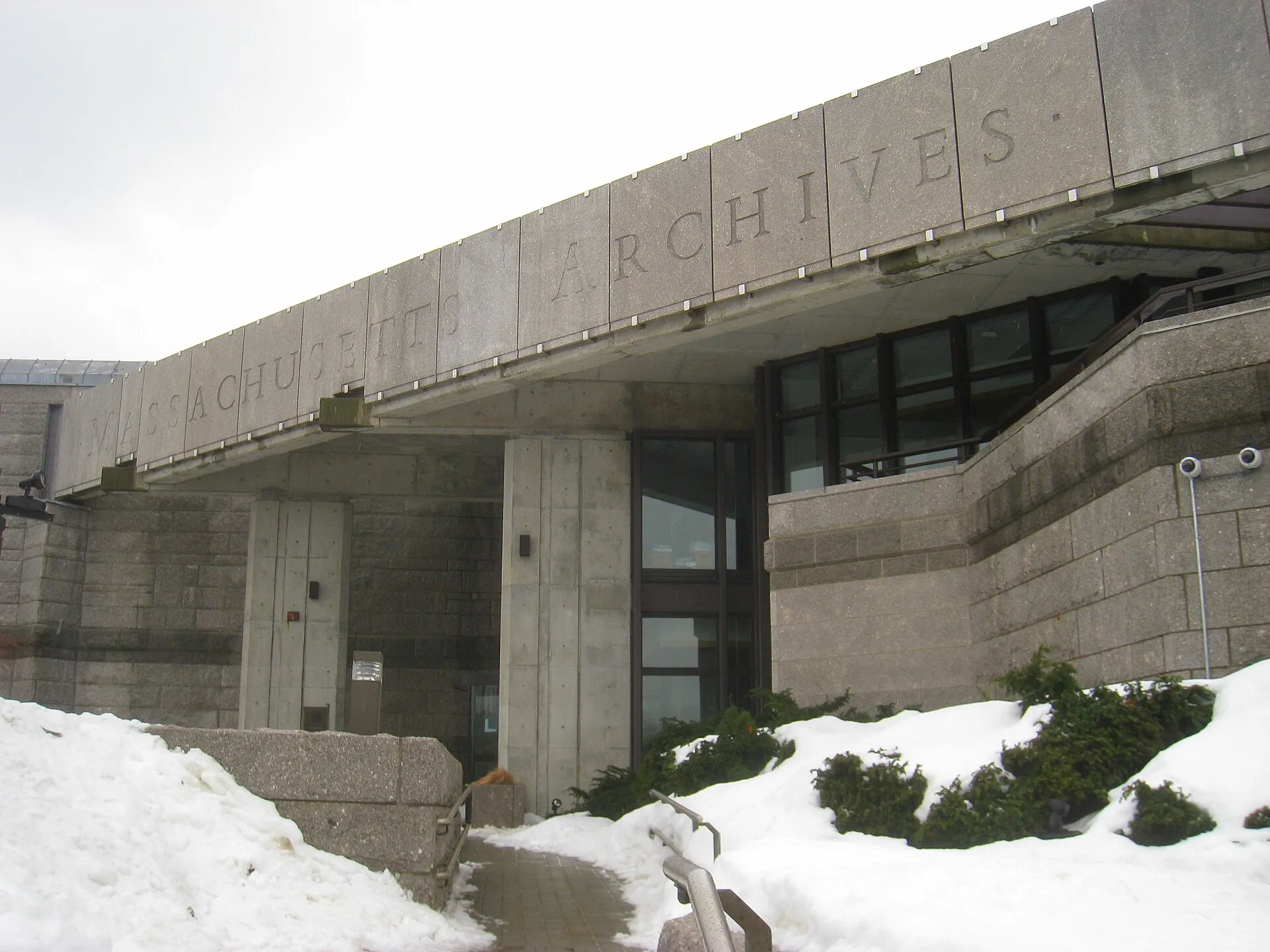
The Massachusetts state archives at Columbia Point in Boston is the state's official repository for permanent government records, and it holds the copies that town clerks sent to the Commonwealth. Birth registers, marriage returns and death records arrive as bound volumes and microfilm, organized by town and year.

For a name researcher, that means you can trace when a given first name first shows up in a specific place, not just how often it appeared nationwide.
Town clerk records are the deeper layer. Massachusetts has 351 cities and towns, and each kept its own books before sending copies to the state. Many local volumes now sit in historical societies or town halls, while the state archives holds the official duplicate.
The two do not always match. A name spelled one way in the town book and another in the state copy is a normal finding, not an error.
The archives also hold manuscript census schedules for Massachusetts, tax valuations, military rolls and state hospital registers. Each of these can carry a name, an age and a residence.
That combination is what separates a documented name from a remembered one, and it is the same discipline behind state-by-state baby-name restriction research, which is only as good as the document behind it.
Access is free and open to the public. You request boxes in the reading room, you cannot browse the stacks, and photography rules vary by collection. Staff pull materials on a schedule, so a single visit rarely covers more than a few towns. Plan around one town or one record series per trip.
Transcribed town records and name-research datasets
Name research needs coding work that raw registers cannot do on their own: someone has to turn handwritten entries into searchable tables. In Massachusetts the best-known public route is the New England Historic Genealogical Society (NEHGS), whose AmericanAncestors.org database carries transcriptions of town records.
Transcribed name lists with standardized spellings are what make quantitative work possible. Without standardization, you cannot count anything. Before you count, check how each transcription grouped spelling variants, and go back to the register image for any entry your argument depends on.
Onomastics, the formal study of names, looks at naming frequency, spelling variation and the drift of given names across generations. Studies of this kind usually work from small, regional samples, which is exactly what Massachusetts town records provide.
A third stream is demographic and genealogical computing, where researchers link name records to census and tax data. This is where a name can be connected to a household, an occupation and a migration path. The output is often a public dataset with a codebook rather than a finished article.
These datasets are not name-popularity trackers. They rarely publish annual rankings, and they do not update on a news cycle. What they publish is historical structure: how names moved through a population over decades. If you want current movement, a resource on celebrity adoption records by state built for that purpose is a better starting point.
How archival name data differs from SSA national rankings
The Social Security Administration publishes the annual list of baby names drawn from Social Security card applications, and that baby-name database covers names given from 1880 onward. It is national, it is yearly and it is free to query. It is also a byproduct of an administrative system, not a census of every birth.
Massachusetts archival data is the opposite in almost every respect. It is local, it is tied to a town and a date, and it survives as an image or a transcription rather than a clean count. It covers births that never generated a Social Security number, which matters for anything before the 1930s.
Massachusetts archival records
- Scope
- One town or county
- Unit
- Named individual with date
- Start
- Colonial era for some towns
- Access
- Reading room, microfilm, scans
- Use case
- Dating and locating a name
SSA national rankings
- Scope
- All 50 states
- Unit
- Count of names per year
- Start
- 1880
- Access
- Free online query
- Use case
- Ranking and trend lines
The SSA background page is explicit that the data reflects card applications and that state-level detail is limited, so a national rank can hide a name that was common in one region and rare elsewhere.
For readers who want the longer view of how these two sources fit together, the naming trends worth taking seriously material covers the methodological side.
Neither source is a family tree. A birth register entry names a child and parents; it does not establish lineage beyond that entry. A family trees list built on linked records is a different kind of object from a ranking table, and conflating them is the most common error in popular name writing.
Vital-records requests through the state office
Massachusetts birth, marriage and death records are held by the Registry of Vital Records and Statistics, part of the Department of Public Health, under M.G.L. c. 17. The state office has birth records from 1931 to the current year; all earlier years are at the State Archives, the Massachusetts Archives at Columbia Point, 220 Morrissey Boulevard, Boston, MA 02125, as well as with town clerks. That split is the first thing to check before you file anything. The registry itself is at 150 Mount Vernon Street, 1st Floor, Dorchester, MA 02125-3105.
Requests go to the registry by mail or in person, with a form, a fee and proof of identity. Who may obtain a record depends on the record type and the relationship. Birth records have restricted access for privacy reasons, and the rules differ for a person requesting their own record and a researcher requesting someone else's.
The CDC's application guidelines for state vital records offices set out the common requirements across states, including identity documentation and the limits on who can request a restricted record.
The CDC's state vital records directory gives each state office an entry like this one, with its address, cost of a copy and accepted payment. The Massachusetts entry in that directory puts the cost of a birth, death or marriage copy at $20.00 in person, $32.00 by mail request and $3.00 from the State Archives. Payment is by personal check or money order made payable to the Commonwealth of Massachusetts, and a recorded-message line, (617) 740-2600, gives current fees.
- Identify the event year and the town where the birth, marriage or death occurred.
- Decide whether the record sits with the town clerk, the state archives or the Registry of Vital Records and Statistics.
- Download the registry's application form and complete every field, including the purpose of the request.
- Attach a photocopy of acceptable identification and the correct fee.
- Mail the packet to the registry's Dorchester address and keep the tracking number, then allow several weeks for processing.
Genealogists often need the pre-1931 records, which means the archives or the town rather than the registry. Adoption and paternity records follow separate rules and usually require a court order.
If your project involves living people, check the privacy expectations before you publish anything, and treat coverage of current celebrity births as provisional until records catch up.
What local transcriptions add to national baby-name reporting
Local transcriptions add three things that national rankings cannot: place, spelling and context. A national list tells you that a name rose. A Massachusetts dataset can tell you which towns adopted it first, how it was spelled in the register and what kind of household used it.
Spelling variation is the quiet contribution. Before standardized spelling took hold, the same name could appear five ways in one county. National counts collapse those variants, which understates how common a name really was. Local transcriptions preserve the variants and let a researcher decide how to group them.
Context comes from linkage. When a name record is joined to a census schedule, you learn the household's occupation, birthplace and neighborhood. That is how researchers test claims about class, immigration and naming fashion instead of asserting them.
Regional concentration is the practical payoff for writers. A name that looks like a national fad may be a local one, or the reverse. Reporting that ignores this will misread a state-level pattern as a national shift, and readers who live in the state will notice.
The limits are real. Academic datasets are built from surviving records, and survival favors some towns over others. Coastal and older towns are better documented than inland ones, and records for some populations are thin or absent. A dataset is evidence about what survived, not about everyone who lived.
Limits of archival evidence in a celebrity name story
Archival evidence can establish that a name appears on a document on a date. It cannot establish why parents chose it, and it cannot establish a relationship the document does not state. Most celebrity name stories need both, which is why they so often go wrong.
A birth record is a legal document filed by an informant, usually a parent or a hospital clerk. It records what someone reported, not what a family felt or intended. Treating it as a statement of motive is a category error.
- Confirm the record exists and note the repository, volume and page.
- Check whether the name is the registered spelling or a later variant.
- Separate what the document states from what a secondary source claims.
- Identify the informant and the date of filing.
- Note any sealed, amended or restricted portion.
- State plainly what the record does not prove.
- Avoid linking a name to living relatives without a documented source.
Privacy law matters here. Massachusetts restricts access to recent birth records, and federal guidance on family and children's data shapes what a publisher should collect and republish. A name taken from a restricted record and posted publicly can create a real problem for the family, not just an ethical one.
A worked example shows the pattern. Suppose a report claims a well-known family gave a child an unusual first name in a Boston suburb in the 1990s. The registry will not release that record to a stranger. The town clerk will not either.
The only available evidence is the report itself. The honest write-up says the name is reported, names the outlet and stops there.
That is the standard to hold. Archival research in Massachusetts can date a name, locate it and show how it was spelled. It cannot confirm a motive, a nickname or a family story, and a story that pretends otherwise is not research.